Make sure you know the type of wood you are finishing before you start sanding...the type of wood you are sanding has a direct relationship to the grit used for the final sand! Soft woods such as pine and fir & closed grain hardwoods such as cherry, maple, birch and alder should be sanded with a 150 or 180 grit prior to the application of a finish. Open grained hardwoods like oak, ash, mahogany and walnut can often be finish sanded with a 220 grit.
The coarser the final grit size used, the darker the finish when using stain. Conversely, the finer the grit size, the lighter the finish will be. This also comes into play when sanding end grain. Always sand end grain one or two grades finer than the rest of the wood. Because end grain will take stain more readily than face grain (like coarser finished wood), by sanding to a finer finish you'll close the grain up a little and it won't accept as much of the stain.
Always test your finish sanding on a scrap piece of wood if possible. This will determine the correct sequence of sanding steps you need to achieve the desired color. Unfortunately, once the stain or color has been applied to your work, the only way to get it back off is to strip or sand it off and start all over again!
Questions? Give us a call at 800-814-7358 or visit us online at: www.abrasiveresource.com
January 12, 2007
October 30, 2006
Sanding Plastic
One of the biggest issues you must confront when sanding plastic is heat...sanding friction causes heat, and plastic parts absorb the heat. Metal parts also warm up from the sanding friction, but metal tends to reflect the heat back out again. Because plastic parts absorb heat, they can soften or even re-flow under power sanding.
Sanding plastic is a good thing--it effectively doubles the surface area, providing twice the opportunity for a new coating to adhere to the surface. Even a light scuff-sanding will help with adhesion...there are just more places for the new coating to cling to.
On the other hand, too much sanding can cause problems--like the "hairing" that you'll see when some plastics split and melt into hair-like strands. Too much power sanding can also cause thermoplastics to reflow. After a forceful sanding, the scratches are very evident. But walk away and when you return just minutes later, the scratches have disappeared--the heat melts them flat again.
The moral of the story is: always be careful on plastic parts. Turn the air pressure way down or even sand by hand to avoid heat buildup!
For more information on sanding plastics, check out our website at www.abrasiveresource.com


September 28, 2006
Polished Finishes on Stainless Steel
The most popular finish in stainless steel fabrication is the No 4 finish--the easiest to maintain and one with a nice surface appearance. A No 4 surface is produced by cutting the surface with coated abrasive belts to remove a very small amount of metal without affecting its thickness. Because it is directional, it allows for easy matching of surfaces. The "official" definition of a No 4 finish is "a linearly textured finish that is produced with mechanical polishing. The average surface roughness (Ra) may generally be up to 25 micro-inches (0.64 micrometeres)."
The Specialty Steel Industry of North America has set guidelines for polished finishes on stainless:
No 3: An intermediate polished surface obtained by finishing with a 100 grit abrasive. Generally used where a semi finished polished surface is required. A No 3 usually receives additional polishing during fabrication.
No 4: A polished surface obtained by finishing with a 120-150 grit abrasive, following initial grinding with coarser abrasives. This is a general purpose bright finish with a visible "grain" which prevents mirror reflection.
With the introduction in recent years of non-woven abrasives, many fabricators are also using a medium non-woven belt to achieve the No 4 finish. If you have other questions regarding finishing stainless, please feel free to call Abrasive Resource at 800-814-7358, or visit us online at: www.abrasiveresource.com
September 14, 2006
Sanding Backing Pad
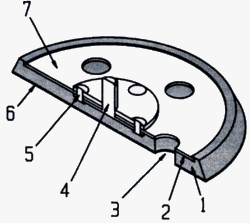
A quality disc sander back-up pad should have:
1. A specially designed, environmentally friendly, molded polyurethane foam, that dampens vibration to prevent your tool from bouncing, yet is flexible and tough enough to withstand the rigorous operation of dual-action random orbit sanders. A permanent bond between the polyurethane and other components of the pad eliminates separation problems.
2. A rugged thermoset fiberglass epoxy backing, that withstands the abuse of heat, flexing and impact, to keep the pad running flat and true for a long time. Aluminum backings bend from impact and lose their flatness, while heat and flexing cause molded plastic backings to warp, distorting the face of the pad. A pad that is not flat causes vibration--which fatigues the user and compromises your finish.
3. Full 1/2" diameter vacuum holes that match the industry standard in sanding discs and allow maximum performance of your tool's vacuum system.
4. A durable welded and plated stud assembly. Welding assures a permanent alignment between the pad and the tool. Plating assures easy pad removal by preventing corrosion.
5. A stud assembly that is rigidly attached to the backing with four rivets. Stud assemblies that are molded in place can loosen and strip causing poor performance and difficulties when removing the pad from the tool. A large, flat, raised steel washer with a four rivet attachment forms an ideal distributor of stress. This assures perfect alignment with all tools, and allows the pad to remain in service for a long time.
6. An embossed vinyl facing or hook facing that is intimately molded with the polyurethane to create a permanent durable and flat surface. Embossed vinyl facings offer maximum adhesion with PSA style paper while operating the tool, yet allow quick and easy replacement. Quality hook facings also offer secure adhesion yet quick and easy removal.
7. Strict tolerance on weight, balance, roundness, and flatness. A pad that is not the correct weight, out of round, out of balance, or not flat causes vibrations which fatigue the user and prevent creating a professional finish. Strict tolerances assure you that each pad performs consistently for a long time.
Abrasive Resource carries back-up pads in stock for same day shipping in both the embossed vinyl facing for PSA or the hook facing for hook-n-loop discs. Check out our website at: www.abrasiveresource.com
August 29, 2006
The History of Abrasives
Think of a product. Any product. Somewhere in the making of that product an abrasive application takes place. The use of abrasives goes back almost since the beginning of recorded history. Prehistoric men, for example, sharpened their tools and weapons by rubbing them together.
Stone used in building the Pyramids of Egypt were smoothed with a naturally "bonded" abrasive--sandstone! Around 2100 B.C. a creative Egyptian engineer mounted a circular wheel on a crude sort of lathe and ground bronze tools and ornaments, launching the art of cylindrical grinding. During the Middle Ages, armor and swords were ground and polished. The first recorded manufacture of coated abrasives goes back to the 13th century when the Chinese used natural gums to bind crushed seashells to parchment.
At the turn of the century, coated abrasives took a giant step forward with the development of the new electric furnace grains, silicon carbide and aluminum oxide. Over the years, sanding became even more popular as a number of new products emerged on the scene and on the production line. Sanding had an impact on all these products--wood and metal as well as glass. Henry Ford, for example, did more for the metal grinding industry than anyone in history.
Ford realized that an ounce of extra weight in any part acted and reacted upon every part. His demand for light parts of great strength created the first big tonnage of alloy steels, whose sensitivity to heat treatment not only fulfilled his requirement of strength without weight but called for grinding to finish instead of cutting with metal tools.
Through the Industrial Revolution, the post-World War II economic boom and a surging economy in the 1990's, abrasives have always been a part of the production process, and they will continue to do so in this millennium.
Information for this article was taken from Chapter 1 "The History of Abrasives" in the Abrasives Product Training Manual published by the Industrial Distribution Association awhile back. The IDA has now merged with the Industrial Supply Association. To learn more about this resource for distributors, visit www.isapartners.org. For more information on abrasives and sandpaper, please check out our website at:
www.abrasiveresource.com
Stone used in building the Pyramids of Egypt were smoothed with a naturally "bonded" abrasive--sandstone! Around 2100 B.C. a creative Egyptian engineer mounted a circular wheel on a crude sort of lathe and ground bronze tools and ornaments, launching the art of cylindrical grinding. During the Middle Ages, armor and swords were ground and polished. The first recorded manufacture of coated abrasives goes back to the 13th century when the Chinese used natural gums to bind crushed seashells to parchment.
At the turn of the century, coated abrasives took a giant step forward with the development of the new electric furnace grains, silicon carbide and aluminum oxide. Over the years, sanding became even more popular as a number of new products emerged on the scene and on the production line. Sanding had an impact on all these products--wood and metal as well as glass. Henry Ford, for example, did more for the metal grinding industry than anyone in history.
Ford realized that an ounce of extra weight in any part acted and reacted upon every part. His demand for light parts of great strength created the first big tonnage of alloy steels, whose sensitivity to heat treatment not only fulfilled his requirement of strength without weight but called for grinding to finish instead of cutting with metal tools.
Through the Industrial Revolution, the post-World War II economic boom and a surging economy in the 1990's, abrasives have always been a part of the production process, and they will continue to do so in this millennium.
Information for this article was taken from Chapter 1 "The History of Abrasives" in the Abrasives Product Training Manual published by the Industrial Distribution Association awhile back. The IDA has now merged with the Industrial Supply Association. To learn more about this resource for distributors, visit www.isapartners.org. For more information on abrasives and sandpaper, please check out our website at:
www.abrasiveresource.com
July 19, 2006
Metal Finishing
There is an excellent article in the archives at the website for the e-magazine "The Fabricator". It's called "Choosing the right coated abrasive for plate finishing applications". I'll tease you with a little bit here, but make sure you check out the full article at www.thefabricator.com
Ceramic aluminum, a sharp microcrystalline grain, cuts aggressively under light to moderate pressures. Its quick cutting capability makes it suitable for grinding stainless steel, titanium, and high-nickel alloys. It works well on applications in which high rates of stock removal are required under light pressures, such as when plates require rounding or dimensioning. Ceramic aluminum’s microcrystalline structure gives it a very long life. It is temperature-sensitive, meaning that removing heat from the cut extends the life of the grain. Quite often ceramic products require grinding aids to reduce heat.
Zirconia alumina, although less expensive than ceramic aluminum, also is a single crystal that is very tough and sharp. In fact, this grain is so tough that it withstands heat very well. However, a common problem with zirconia grain is glazing, which occurs when the grains dull from insufficient grinding forces. Rubbing the dulled grains causes the metal to adhere to the tips of the grain. Reducing glazing requires heavier grinding forces to fracture the grain and enable resharpening. Therefore, zirconia lends itself to the higher temperatures and heavier pressures that are present in high-stock-removal applications.
Zirconia’s advantage over ceramic primarily is its performance in high-heat and heavy-pressure applications, such as those characterized by mechanically applied pressures that generate a large spark array. The heavy grinding pressures effectively resharpen the grain, promoting long wear life without adverse effects from the high temperatures. Plate examples are power-pack grinding of castings and automated grinding of fixtured tools.
Aluminum oxide is a single-crystal grain used in most polishing applications because of its durability and longer service life than silicon carbide’s. This grain is less tenacious than ziconia and therefore requires less pressure to prevent glazing. Soft metals, such as aluminum and some carbon and stainless steels, usually are good candidates for aluminum oxide grain products. For the most part, these metals are not as sensitive to the heat that is sometimes generated by the aluminum oxide grain because of its crystalline structure.
Silicon carbide, also a single-crystal grain, is the sharpest and hardest of all grains, but it is also the most brittle of all, resulting sometimes in a short service life. This grain’s advantage is its ability to work well on very hard, tenacious metals such as titanium, cobalt, and INCONEL® alloys. Silicon carbide’s sharp shape and extremely hard properties make it the most suitable grain to work on these metals. Conversely, the “blocky” nature of aluminum oxide grain renders it incapable of penetrating these surfaces efficiently, causing higher heat generation and resulting in a shorter service life.
In addition, because of silicon carbide’s sharp, slender shape, it produces a brighter finish profile on stainless steel and some carbon steels.
You can subscribe to The Fabricator by going to: www.thefabricator.com
For more information on sanding and sanding products, check out our website
www.abrasiveresource.com
Ceramic aluminum, a sharp microcrystalline grain, cuts aggressively under light to moderate pressures. Its quick cutting capability makes it suitable for grinding stainless steel, titanium, and high-nickel alloys. It works well on applications in which high rates of stock removal are required under light pressures, such as when plates require rounding or dimensioning. Ceramic aluminum’s microcrystalline structure gives it a very long life. It is temperature-sensitive, meaning that removing heat from the cut extends the life of the grain. Quite often ceramic products require grinding aids to reduce heat.
Zirconia alumina, although less expensive than ceramic aluminum, also is a single crystal that is very tough and sharp. In fact, this grain is so tough that it withstands heat very well. However, a common problem with zirconia grain is glazing, which occurs when the grains dull from insufficient grinding forces. Rubbing the dulled grains causes the metal to adhere to the tips of the grain. Reducing glazing requires heavier grinding forces to fracture the grain and enable resharpening. Therefore, zirconia lends itself to the higher temperatures and heavier pressures that are present in high-stock-removal applications.
Zirconia’s advantage over ceramic primarily is its performance in high-heat and heavy-pressure applications, such as those characterized by mechanically applied pressures that generate a large spark array. The heavy grinding pressures effectively resharpen the grain, promoting long wear life without adverse effects from the high temperatures. Plate examples are power-pack grinding of castings and automated grinding of fixtured tools.
Aluminum oxide is a single-crystal grain used in most polishing applications because of its durability and longer service life than silicon carbide’s. This grain is less tenacious than ziconia and therefore requires less pressure to prevent glazing. Soft metals, such as aluminum and some carbon and stainless steels, usually are good candidates for aluminum oxide grain products. For the most part, these metals are not as sensitive to the heat that is sometimes generated by the aluminum oxide grain because of its crystalline structure.
Silicon carbide, also a single-crystal grain, is the sharpest and hardest of all grains, but it is also the most brittle of all, resulting sometimes in a short service life. This grain’s advantage is its ability to work well on very hard, tenacious metals such as titanium, cobalt, and INCONEL® alloys. Silicon carbide’s sharp shape and extremely hard properties make it the most suitable grain to work on these metals. Conversely, the “blocky” nature of aluminum oxide grain renders it incapable of penetrating these surfaces efficiently, causing higher heat generation and resulting in a shorter service life.
In addition, because of silicon carbide’s sharp, slender shape, it produces a brighter finish profile on stainless steel and some carbon steels.
You can subscribe to The Fabricator by going to: www.thefabricator.com
For more information on sanding and sanding products, check out our website
www.abrasiveresource.com
Sanding Wood
I thought we had one of the only blogs that extolled the virtues of sandpaper. Well, while doing an Internet search I ran across another blog where the writer sings the praises of sanding! It's called "Stay of Execution" and this entry is from awhile back, but let me share a little bit of it with you...
Isn't Sherry a good writer? She has captured the emotions behind sanding wood--a tactile, artistic sense of accomplishment! To see the whole entry, visit her blog at:
Stay of Execution
For more information on sanding and sanding products, check out our website
www.abrasiveresource.com
I don't do it much, but there's something that I've always loved about sanding wood. I like the repetitive back and forth, feeling the slight scrape beneath my fingers. I like seeing the soft tracks that the sandpaper leaves in the wood, a dusty faded trail. I like touching the wood and feeling its texture, the rough spots that you haven't gotten to and the smooth powdery feel where you have already been. The wood dust on your fingers and even the way it tickles your nose a bit...
Isn't Sherry a good writer? She has captured the emotions behind sanding wood--a tactile, artistic sense of accomplishment! To see the whole entry, visit her blog at:
Stay of Execution
For more information on sanding and sanding products, check out our website
www.abrasiveresource.com
Subscribe to:
Posts (Atom)
Basic Sanders
The basic styles of portable sanders haven’t changed very much over the years. We have some old advertising posters from the Rockwell Manuf...
